
A Policy Stack to Save America
EIG’s Year in Review 2025

Think back to 2015. Barack Obama was president, Facebook and Twitter were still called Facebook and Twitter, and Tiktok had not yet launched. The dystopic and dreamy AI worlds of popular new releases like Her and Ex Machina appeared distant.
The unemployment rate was above 5 percent and coming down slowly. The federal budget deficit as a share of the economy was less than half its current level.
If you had invested in a broad index of American stocks at any point in 2015, you would have tripled your money by now. Or you could have bought a share of Nvidia for less than a single dollar and a Bitcoin for about $300, but do yourself a favor and avoid looking at today’s price for either.
Donald Trump came down the escalator in 2015, though the possibility that he would become president was at first laughed away. Then it wasn’t.
Finally, 2015 was the year that the Economic Innovation Group was launched.
We just marked our decennial anniversary with our most productive year yet, and our busiest. In 2025, our signature policy idea became a permanent feature of the American economy. We published more reports and analyses than ever before and entered into new policy domains.
We welcomed the arrival of new colleagues, including a research director with a specialty in the single biggest economics trend of the moment. We hosted a big party and an even bigger conference. It was the first full year of this very newsletter, our new podcast, and our foray into videos.
Our work on housing, economic geography, skilled immigration, trade, artificial intelligence, economic statistics, and other topics generated more media coverage and commentary than in any other year of our brief history.
Against the backdrop of extraordinary turbulence in American politics and the economy, things didn’t always come easy. Very often we were reminded of the old quip that there are decades where nothing happens and weeks where decades happen.1 In 2025, every week felt like that.
But it was a helluva ride, and we can’t wait for 2026. Below we highlight our biggest achievements and milestones from the past year, and look ahead to what’s coming next.
One Big Beautiful Policy Win
Did you know that EIG first proposed Opportunity Zones, a novel tax incentive to spur private investment in low-income areas throughout the country, in a white paper by Jared Bernstein and Kevin Hassett in 2015? (You can still read it!)
Our first signature policy win, OZs were passed into law as part of the Tax Cut and Jobs Act of 2017. They have since gone on to become one of the largest economic development initiatives in American history.
In 2025, not only were OZs made permanent in the One Big Beautiful Bill Act, but Congress also included a slew of recommendations from EIG for how to improve their design. These included sweeping new reporting and transparency requirements that will help the public track the economic effects of OZs in the future.
But we didn’t pause to celebrate, not for long anyways. Too much work remains to be done.
We published an explainer of the relevant changes and released our Guidance for Governors, which will help states decide which census tracts should be designated as OZs.
Finally, we have continued our work on the impact of Opportunity Zones on the economy. Read the details in our latest white paper, which presents first-of-its kind evidence that place-based policies can actually succeed.
You can also grasp the significance of the policy just by looking at this remarkable chart of the effects of OZs on the housing market specifically (via our summary post):

In 2026, we plan to continue our work advising policymakers throughout the country on how to make Opportunity Zones work best for their constituents in addition to updated analysis on the effects of OZs.
Against the Flow
We started the year by introducing Exceptional by Design, our new proposal to overhaul and expand the high-skilled immigration system.
Our plan is the product of three years of intensive research and creative thinking. As of now it is the only high-skilled immigration proposal that comprehensively explains how all the pieces of the byzantine current system fit together — and how they should be reformed to benefit American workers and communities.
As we write:
High-skilled immigration can help us address our most pressing national challenges, from intensifying competition with China to sparking growth in lagging regions. But harnessing this tool requires a more comprehensive view of immigration’s economic effects — and a more realistic understanding of the immigration bureaucracy’s capabilities — than either pro-immigration advocates or restrictionists have to offer.
In short, we need to reimagine policy to make high-skilled immigration the centerpiece of the U.S. immigration system, rather than an afterthought.
Our plan also exposes every myth that prevents policymakers from understanding the issue correctly — including those shared by well-intentioned advocates of immigration.
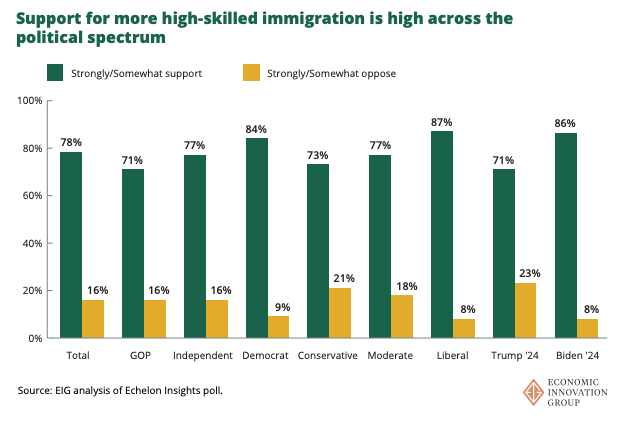
Among the prevalent myths is that now is a bad time for high-skilled immigration reform, with border issues and negative sentiment about the economy having turned Americans inward. It is simply false. Few issues command such widespread bipartisan support:
Go to the Exceptional by Design site, where you can read the full plan or a summarized version, ask a chatbot about it, see videos, and more.
You can also listen to our podcast episode about our ideas or read one of the many follow-on pieces. Exciting new additions to the work we’ve already done on this topic will be arriving early in 2026, so make sure you’re subscribed to Agglomerations to find out about it.
New Frontiers
Nathan Goldschlag became EIG’s new research director in April 2025. In his former role as Principal Economist at the U.S. Census Bureau’s Center for Economic Studies, Nathan led research on business dynamics and the impact of technology, including Artificial Intelligence, on the economy.
Shortly after joining, Nathan and editorial director Cardiff Garcia chatted on The New Bazaar, EIG’s flagship podcast, about the evolving use of AI at American businesses and its possible effects on the labor market. Not only was it the most-listened episode of the year, it also jumpstarted EIG’s work on the effects of AI.
Nathan’s analysis with EIG researcher Sarah Eckhardt, AI and Jobs: The Final World (Until the Next One), found no causal evidence that AI was having an effect on unemployment. In a post summarizing their findings, they add:
Beyond unemployment rates, we also find that AI-exposed workers were not more likely to exit the labor force or switch occupations, nor that firms were detectably altering how they assign tasks to workers based on AI’s capabilities. No matter which measure we use or which labor market outcome we look at, we just don’t see AI causing dramatic upheaval in the labor market.
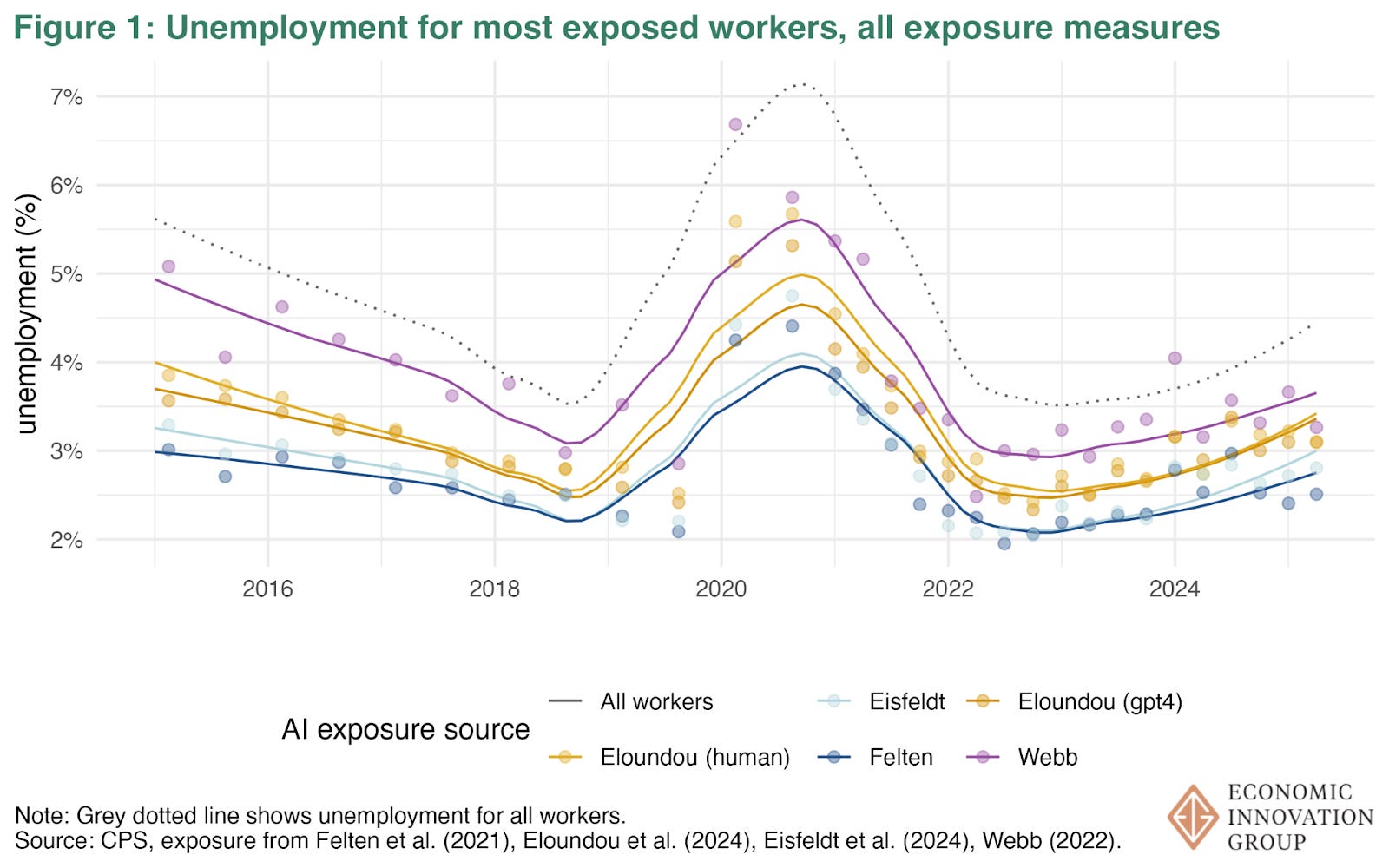
The essay was shared widely and ended up generating discussion in places like The Atlantic, the Financial Times, The Economist, and in the newsletters of economics writers like Noah Smith, Derek Thompson, and Tim Lee.
The essay also coincided with our work explaining public views about AI, a post looking again at the share of businesses using AI, and another on why policymakers should be cautious about trying to steer the economy in response to advances in AI.
Picking Fights Respectful Disagreements
Tariff troubles
We were not fans of the Liberation Day tariffs. But rather than merely add to the cacophony of typical critiques about tariffs, we decided to try something different. We wanted a way to judge the tariff policies of the Trump administration on its own terms.
We therefore introduced the Tariff Policy Dashboard, an interactive tool “for evaluating whether the core promises of the Trump administration’s trade agenda are being fulfilled.”
Updated quarterly, the dashboard the dashboard tracks 15 key indicators across five categories:
Trade flows
Budgetary impacts
Manufacturing employment
Manufacturing output
Macroeconomic effects
Our coverage of trade policy and protectionism didn’t end there. CEO John Lettieri wrote a personal essay about his childhood in South Carolina, where he witnessed the launch and development of BMW’s Plant Spartanburg. The combination of foreign investment, international trade, and domestic sourcing completely transformed a struggling local economy. The essay was a response to the confused ramblings of Peter Navarro, senior advisor to the president.
And in one of the year’s surprise hits, chief economist Adam Ozimek published a detailed study of auto vehicle protectionism in the United States over the past century. Historical trade barriers on cars and trucks are often summoned as examples of protectionist success stories, but those familiar narratives rely on four myths, Adam writes:
The U.S. auto industry has collapsed.
Globalization caused the death of Detroit.
Japanese imports nearly destroyed the auto industry in the early 1980s…
… until auto protectionism saved it.
Wrong, wrong, wrong, and wrong.
In defense of the stats agencies
The nation’s statistical agencies came under fire this year. The president and his advisors even accused the Bureau of Labor Statistics of having “rigged” economic indicators when the jobs data failed to match the expectations of the administration.
In a project spearheaded by EIG senior fellow Kenan Fikri, we drafted a bipartisan letter to Congress signed by more than 80 leading economists calling for investment in the stats agencies, not attacks and retrenchment — so that the agencies, whose budgets have been falling sharply in real terms for many years, can keep up with an era of AI and the digitization of everything.
From the letter:
As creators of information, [the stats agencies] provide an essential input to our knowledge-based economy. The work of the agencies and their staff directly contributes to the exceptional performance of the American economy and to the quality of our public policymaking.
We urge you to invest in that innovation, invest in the needed modernization, and invest in the information that will fuel the next great era of American economic growth. The world’s most formidable economy deserves the world’s foremost statistical system.
As a follow-up to the letter, we hosted a Q&A with John Haltiwanger, Distinguished University Professor in the Department of Economics at the University of Maryland (and member of EIG’s Economic Advisory Board). Few economists have deeper knowledge of federal statistics and why they matter — and of how the stats agencies must evolve for the digital present and future.
INTERLUDE: THE OTHER KIND OF POLITICAL PARTY
In September we hosted a 10-Year Anniversary bash at Ned’s Club, featuring the ‘90s cover band White Ford Bronco. The pictures tell the tale of how it went:

And in November we hosted our annual Power of Place Conference at the Georgetown Ritz-Carlton. Check out Kenan Fikri’s writeup of a wonderful day devoted to the hopeful possibilities and, if done poorly, the perils of place-based policies. Also, lots and lots of maps:

Finally, we were delighted to join our friends at other think tanks and organizations in co-sponsoring the second annual Abundance Conference.
Need Housing? Come Stay At Our Place.
Without giving too much away, within the next few months readers will be hearing a lot more about EIG’s housing work.
In 2025, one of our most popular articles was Not Just Suburban Sprawl — Dense Places Can Still Build, in which newcomer Jess Remington explored the relationship between density and housing construction. The findings were nuanced and, to many readers, surprising. For example: “The densest 10 percent of tracts — the downtowns and urban cores — are building more housing relative to their populations than the next 20 percent — the inner-ring suburbs surrounding downtown neighborhoods.”

We also published The Era of Federal Zoning Reform Has Arrived this year. Jess Remington, Adam Ozimek, and Carol Neuhardt write that the ROAD to Housing Act, which ended up passing the Senate, “has shifted the Overton window on what’s possible.”
Not only did the bill represent a massive step forward in the federal government’s potential involvement in zoning reform, it also paved the way for Right-to-Build Zones, an idea that EIG first proposed in 2024.
Again, much more on these ideas coming soon in 2026.
Let’s Run It Back
Every year we update several of our flagship reports with the latest data. These reports are all groundbreaking in their own way, and each year brings new revelations. Here they are, with quotes from either the reports themselves or the summaries we posted on Agglomerations.
1. The Distressed Community Index
From the roundup by Kenan Fikri and Sarah Eckhardt:
Where you live determines whether you experience that growth first-hand, or sit it out instead. Where you live also affects how long you live, predicting longevity with uncanny reliability. Put simply: Your ZIP code isn’t just for delivering the mail. It’s a summary statistic for your life. And it largely determines whether you’re part of the nation’s exceptional economic story — or one of the exceptions to it.
2. Retirement System: Fact Facts
“The tax-advantaged retirement savings system in the United States is one of the most effective wealth-building programs in the world. Too many working Americans, however, are left behind. Their access to employer-provided retirement plans is limited, and the incentives in the retirement system fail to encourage lower-income workers to save.”

More details, including breakdowns by income and demographics, in the report by Sarah Eckhardt and Benjamin Glasner.
3. The Index of State Dynamism
“After decades of decline,” writes Connor O’Brien, “American dynamism is making a comeback. U.S. economic dynamism has increased in every single state from pre-pandemic levels, partly reversing a long slide that had persisted since at least the 1990s, according to the latest release of the Index of State Dynamism (ISD).”

New-ish Media
Remember to check out The New Bazaar, our chat show about the economy hosted by editorial director Cardiff Garcia. We ramped up the episodes in the last couple of months, and we especially recommend our conversations with the following guests:
Rebecca Allensworth on occupational licensing
Mike Bird on the economics of land
Arnab Datta on rare earths industrial policy
Matt Yglesias on the politics of place
Jerusalem Demsas on the attention economy
We’ve also been dipping into short-form videos, hosted by EIG economist Ben Glasner. You can view them at our YouTube and Instagram pages. Here’s a fun one:
Finally, our profound thanks to readers who found Agglomerations and subscribed or shared our posts. Our audience has grown without interruption throughout the first year of this newsletter, and we greatly appreciate your attention given all the other options you have.
Happy New Year!
No, we don’t often quote Lenin. That’s a good line though.
A tour de force!
One thing I appreciate here is the consistent treatment of place, data, and incentives as systems rather than slogans. Opportunity Zones, zoning reform, immigration flows, and even statistical capacity all read as attempts to move coordination upstream instead of reacting downstream.
What feels increasingly clear is that policy outcomes hinge less on intent than on how these stacks interact over time...especially which defaults harden and which feedback loops stay correctable. That’s where a lot of the long-run risk (and upside) seems to live.
Thanks for the read.