
Monthly Multiplier: EIG's January Highlights

One Big Thing: AI and Jobs
Is AI to blame for the recent employment struggles of young college graduates?
On January 14 we published a guest essay from Zanna Iscenko and Fabien Curto Millet, Google’s lead AI economist and chief economist, respectively, challenging this tantalizing narrative.
The more plausible explanation, they write, “is that the data patterns observed are not early warnings of large-scale technological displacement, but rather the predictable consequences of a classic macroeconomic shock: the sharpest monetary policy tightening cycle in four decades.”
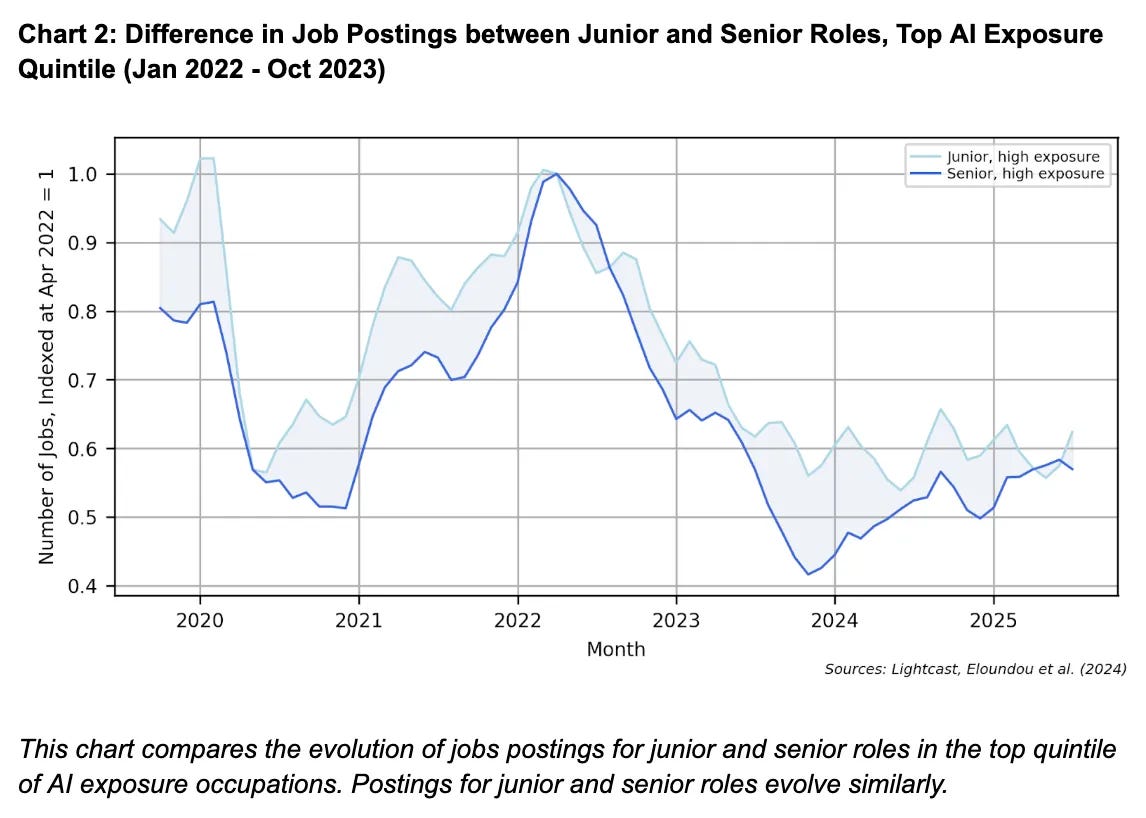
Job postings for both junior and senior roles in AI-exposed fields began to fall six months before the public release of ChatGPT in November 2022. Following its release, postings for junior roles stabilized faster, rebutting the claim that recent grads have been hardest hit by AI.
Read Looking for the Ladder in its entirety at Agglomerations.
Policy
EIG's Sam Peak worked closely with the state legislators behind a new bill in Utah that could serve as a national model for restricting onerous noncompete agreements and unleashing workers' economic potential. Sponsored by Republicans Tyler Clancy and Heidi Balderee, the bill would ban noncompetes for all employees and independent contractors making less than $155,000 and sharply restrict noncompetes above the $155,000 threshold. If enacted, the bill would limit the use of noncompetes to only the most exceptional cases while encouraging entrepreneurship, innovation, and labor competition throughout the state of Utah.

EIG's Sarah Eckhardt, Jason He, and Kenan Fikri jumped on the new 2020-2024 American Community Survey data drop to update EIG’s Opportunity Zones eligibility mapping tool. While we await the official map from Treasury, our interactive map is primed for state and local officials to explore as they get to work identifying the best census tracts to nominate for OZ status this summer.

Research & Analysis
Where are the digital workers?
Which metro areas throughout the United States have the highest share of digital workers as part of their workforce, and where are digital jobs growing the fastest? Sarah Eckhardt takes a look. (840 words)
If international students don’t get H-1Bs, IT outsourcers will
The pathway through which some of the most skilled and productive workers enter the American labor force may soon become much narrower, write Jason He and Sam Peak. “The Trump administration is weighing whether to eliminate or severely scale back the Optional Practical Training (OPT) program, which allows international student visa (F-1) holders to work in the United States after graduating. Our analysis finds that individuals on student visas, including OPT recipients, represent some of the most economically productive H-1B applicants and are among the least likely to be employed by the outsourcing firms often criticized for abusing the H-1B program.” (1,200 words)
The indicators that’ll really signal a manufacturing renaissance
Observing changes in net employment is not enough, writes Kenan Fikri. To assess the health of the manufacturing sector, it’s necessary to look at measures of dynamism, which “captures the very real ebbs and flows of workers and firms in the economy as some businesses start and grow while others contract and disappear. Since the Great Recession, manufacturing firms have created 37 percent fewer jobs in gross terms and on average annually than they did in the 1990s, and 22 percent fewer than they did in the 2000s. The slightly positive net change registered most years in the post-2010 era comes from gross job destruction having fallen by even more — by 43 percent on average each year.” (1,000 words)
The New Bazaar (Our Podcast)
Cardiff Garcia hosted a chat with economist and criminal justice scholar Jen Doleac about her new book, The Science of Second Chances. They discussed why erring towards leniency for first-time offenders so often leads to less reoffending, and the surprising failures of ideas that seem sensible. Along the way they examine the evidence needed to answer questions like:
How long should prison sentences be?
For people who go to prison, what kinds of incentives should we give them for how they spend their time there, how they rehabilitate themselves?
How should we take into account variables like age or mental health?
What happens when someone gets out of prison? What are the best policies to put them on the path to success?
Listen to the episode or read the full transcript here.
Around the Horn
EIG Research Director Nathan Goldschlag published an entry for the Census Bureau’s “America Counts: Stories Behind the Numbers” series on the importance of small firms for game-changing inventions.
EIG Fellow Jordan McGillis wrote an essay for the Dispatch explaining the confusion over manufacturing jobs numbers through his family history at Boeing.
EIG CEO John Lettieri was a panelist at a recent conference about the damaging effects of noncompete agreements on American workers. Hosted by the Federal Trade Commission, John’s panel was titled “Unleashing the American Worker: Policy Perspectives on Noncompetes”.
In the Financial Times, John Burn-Murdoch and Sarah O’Connor cited EIG’s “Looking for the Ladder” on AI and jobs.
InYahoo! Finance, Emma Ockerman cited EIG research on regional disparities in manufacturing employment’s post-pandemic rebound.
In Forbes, Teresa Ghilarducci cited EIG research on workplace retirement plans.
EIG Chart of the Month
Via Kenan Fikri’s Agglomerations post on manufacturing dynamism:

EIG Video of the Month
Presented by Ben Glasner, a playful companion video to our 2025 Charts of the Year. See our YouTube and Instagram pages for more.